Brains
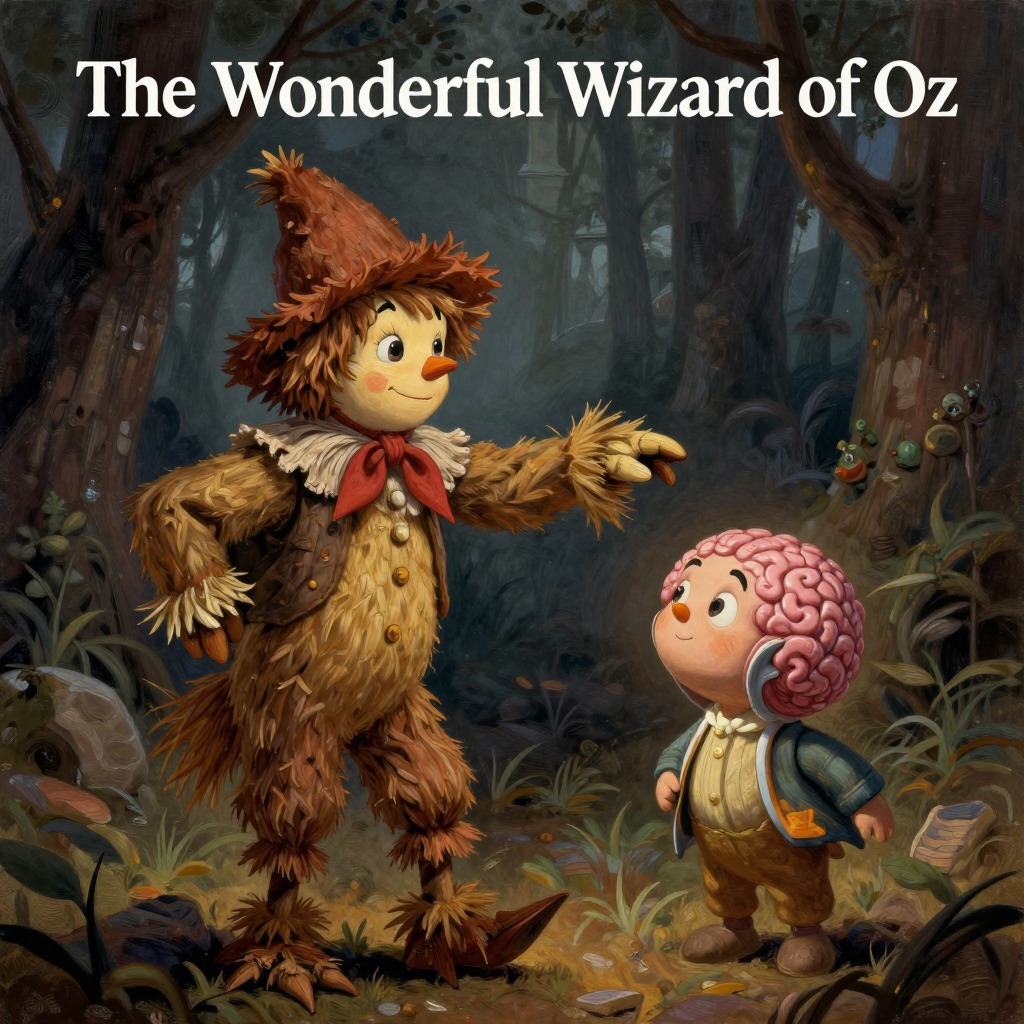
Brains are the central object of the Scarecrow's quest in L. Frank Baum's The Wonderful Wizard of Oz, representing the desire for knowledge, wisdom, and social respect. The Scarecrow, a figure made entirely of straw and lacking any internal substance, believes that without brains he is a fool, incapable of understanding the world or being considered a true man. His journey to the Emerald City to ask the Great Oz for a portion of brains drives much of the plot, and the eventual fulfillment of his wish—through a symbolic, rather than literal, gift—reveals the book's deeper argument about the nature of intelligence and self-worth.
The Scarecrow's Self-Perception and the Value of Brains
The Scarecrow's conviction that he is brainless is the foundation of his character. When Dorothy first meets him, he tells her, "I don't know anything. You see, I am stuffed, so I have no brains at all" . This self-assessment is not merely a statement of fact but a source of deep unhappiness; he fears being called a fool and believes that without brains he cannot know anything. His desire for brains is so strong that he is willing to undertake a dangerous journey to the Emerald City, hoping that Oz will give him "a few brains" . The Scarecrow's longing is not for abstract knowledge but for the practical ability to think, reason, and be respected as an equal among men. He explicitly states, "I do not want people to call me a fool, and if my head stays stuffed with straw instead of with brains, as yours is, how am I ever to know anything?" . This reveals that his quest is driven by a need for social validation and the capacity to participate in the world of thought.
The Political and Social Context of Brains
The concept of brains is also embedded in the political structure of Oz. The Wicked Witch of the East, who held the Munchkins in bondage for many years, is described as having kept them enslaved "night and day" . Her death at the hands of Dorothy's house frees them, but the Scarecrow's quest for brains is a parallel journey toward personal liberation from ignorance. The Great Oz himself, who is later revealed to be a humbug, uses the promise of brains to manipulate the Scarecrow. When the Scarecrow asks for brains, Oz responds, "I never grant favors without some return... If you will kill for me the Wicked Witch of the West, I will bestow upon you a great many brains, and such good brains that you will be the wisest man in all the Land of Oz" . This condition ties the acquisition of brains to a violent act, revealing that in Oz, even the most personal desires are entangled with political power and the demands of authority. Oz's own deception—he is a ventriloquist and balloonist from Omaha who has no magical powers—further complicates the value of brains, as he admits, "I'm not much of a magician" . The Wizard's confession that he is a humbug undermines the very system he has created, suggesting that the brains he promises are as illusory as his own power.
The Symbolic Bestowal of Brains
When the Scarecrow finally receives his brains, the act is purely symbolic. Oz, unable to perform real magic, takes the Scarecrow's head, empties it of straw, and fills it with a mixture of bran and a great many pins and needles . He then declares, "Hereafter you will be a great man, for I have given you a lot of bran-new brains" . The Scarecrow immediately feels wise, stating, "I feel wise indeed... When I get used to my brains I shall know everything" . The pins and needles sticking out of his head are interpreted by the Cowardly Lion as "proof that he is sharp" . This comical, materialist solution underscores the book's central irony: the Scarecrow already possessed the intelligence he sought. Throughout the journey, it is the Scarecrow who devises the plans to cross the great ditch, build a raft, and call the field mice for help. His own actions demonstrate that he has the brains he believes he lacks. The gift from Oz is not a transformation but a confirmation, a physical token that allows the Scarecrow to accept what was already true.
Thematic Significance: Brains as a Construct
The Scarecrow's quest for brains ultimately serves as a critique of the belief that intelligence is a fixed, external quality that can be granted by an authority. The book suggests that wisdom comes from experience and action, not from a magical infusion. When Oz tells the Scarecrow, "You don't need them. You are learning something every day. A baby has brains, but it doesn't know much. Experience is the only thing that brings knowledge" , he articulates the novel's implicit philosophy. The Scarecrow's journey is not about acquiring a new organ but about recognizing his own capabilities. The fact that he is satisfied with the bran and pins—a placebo—demonstrates that his need was for self-confidence, not for actual cognitive enhancement. In this way, brains function as a narrative device that allows Baum to explore themes of self-discovery, the social construction of intelligence, and the power of belief. The Scarecrow's story proves that the desire for brains is often a desire for the permission to use the ones one already has.